
Not long ago, someone gave my son a copy of the book Homer Price and it brought back memories. I remember reading that book when I was a kid. It’s by Robert McCloskey, and in true McCloskey fashion, the book is both endearing and zany. It’s about the adventures of Homer Price, a kid whose experiences are somehow both ordinary and hard-to-believe.
Homer lives in a small town and enjoys tinkering with radios, reading comic books, and engaging in other ancient pastimes that were foreign to me as a child. But I liked the book. It was easy to read and it was fun to watch the laidback Homer stumble into the most interesting situations.
One story that I particularly remember, maybe because it featured on the cover of the book, is the one about the doughnuts.
Homer’s Uncle Ulysses owns a small lunch counter in town. One afternoon, Homer goes to town and stops by to see his uncle. Ulysses is working on his doughnut machine. He’s proud of his machine. It’s truly a modern marvel. All he has to do is mix up the doughnut batter and pour it in and the machine does all the work, dropping rings of batter into the oil, frying one side, flipping them, frying the other, then tossing them down a chute. The resulting doughnuts are warm, fluffy, tantalizing, and refreshingly symmetrical.
The doughnut machine is a wonder to the folks in Centerburg, and when it’s running, they’ll sometimes stand outside the big glass window and watch it work its magic.
Today, when Homer walks in, Uncle Ulysses has dismantled the doughnut machine. He’s cleaned all the parts and he’s in the process of putting it all back together. He’s nearly done, but he hands the job off to Homer, knowing that, since Homer likes to work on radios, he can surely figure out a doughnut machine.
He tells Homer he wants to go out for a few minutes to talk to the sheriff. As he leaves, he calls back to Homer, “Uh, Homer, after you get the pieces in place, would you mind mixing up a batch of doughnut batter and putting it in the machine? You could turn the switch and make a few doughnuts to have on hand for the crowd after the movie… if you don’t mind.”
“OK,” says Homer.
Uncle Ulysses leaves, and Homer gets to work. As Homer is finishing his work on the machine, a man walks into the shop and asks Homer for doughnuts and a cup of coffee. Homer apologizes, explaining that it will be a few minutes before the doughnuts are ready, but the man says he’s willing to wait.
“OK,” says Homer.
Homer is chatting with the man when another customer arrives. This time, it’s a woman in a fancy car, complete with her very own chauffeur. She’s wearing fancy clothes and expensive jewelry and she, too, asks for doughnuts and coffee. Homer has to repeat his apology. The machine is ready, but he still needs to mix up the batter and start the machine.
The woman’s eyes light up. She offers, or rather insists, on mixing up the batter herself. “I know the best recipe for doughnuts,” she says.
Homer tries to protest, but it’s no good. Soon he’s grabbing her an apron and helping her with ingredients. She mixes up an enormous batch of batter. Again, Homer protests, saying it’s far more batter than Uncle Ulysses makes, but he pours it all into the machine anyway and turns it on.
The magic begins. They watch as beautiful fresh doughnuts start pouring out of the machine. Everyone agrees that the woman’s “old family recipe” makes for doughnuts that really are very good. The woman thanks them, pays Homer for two dozen doughnuts, and leaves.
Homer watches the machine make a few dozen more, then, satisfied that they have enough for the after-movie crowd, he pushes the red button on the side of the machine that that says “Stop”. The machine makes a small click, but it keeps running. Homer can’t make heads or tails of it, so he calls Uncle Ulysses.
By the time Uncle Ulysses returns, there are doughnuts everywhere. The window display is full of them, they fill the lunch counter, they are stacked on all the shelves, and they just keep coming, doughnut after symmetrical doughnut rolling down the chute.

Neither Homer nor Ulysses know what to do. All they can do is try to find places to stack the hundreds of doughnuts pouring out of the malfunctioning machine.
Then, things go from bad to worse.
The fancy woman with the old family recipe returns. She bursts in, a look of deep distress on her face. Frantically, she announces, “I’ve lost my diamond bracelet.”
They help her look, moving stacks of doughnuts to make sure it hasn’t become buried, but they can’t find it anywhere. She offers a $100 dollar reward to anyone who can find it, but that doesn’t make any difference. No one knows where to look.
The woman is hysterical about the loss of her jewelry. Uncle Ulysses is hysterical about the state of his lunch counter. The citizens of the town are crowding around the window, watching the drama unfold. It’s pure chaos.
Then Homer decides it time to think. He sits down and ponders the situation.
And as he ruminates, it all comes together. He knows how to fix everything.
He tells the woman where her bracelet is. It must have slipped into the batter when she was cooking and gotten cooked into a doughnut. With over a thousand doughnuts stacked around them and more on the way, this hardly seems like good news, but in a marketing masterstroke, Homer reveals his plan to find the bracelet and sell the doughnuts.
They put up a sign in the window, advertising doughnuts 2 for 5 cents and telling the spectators about the reward. Whoever finds the bracelet will get the $100 reward, but to find the bracelet, they will have to buy doughnuts.
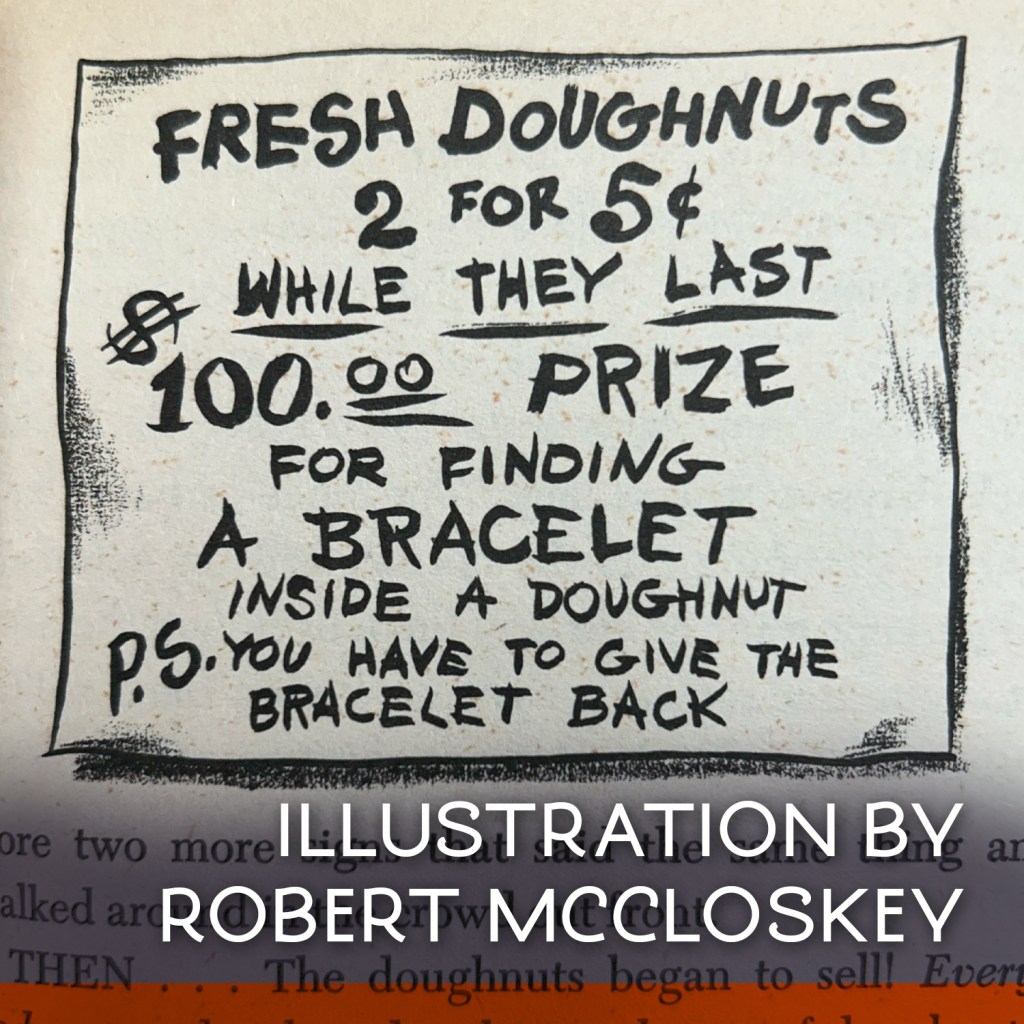
And they do. Soon the crowd moves from outside to inside. Suddenly, everyone wants a doughnut, or two, or a dozen.
Homer and his uncle sell stacks and stacks of doughnuts and gallons of coffee before finally a young man shouts out triumphantly, “I GOT IT!”
Crisis averted. Sure they don’t sell quite all the doughnuts and Uncle Ulysses will still have to figure out what caused the machine to malfunction, but everyone goes home happy and Homer is, once again, the hero of the day.
It’s an outlandish story and I’m left asking all kinds of questions, like,
Who would leave a kid in charge of a lunch counter?
Why would Homer agree to fix the machine and cook the doughnuts when he had never done either before?
Why would the woman dive right into mixing up doughnut batter without making sure her expensive jewelry was safely set aside where it couldn’t get ruined or lost?
Why wouldn’t Homer test the machine before pouring in a giant batch of batter?
For that matter,
How could a single batch of doughnut batter, no matter how large, result in over a thousand doughnuts?
And,
How could Uncle Ulysses’ machine hold that much batter?
Perhaps my favorite question:
When the machine started to malfunction, why didn’t they just unplug it?
But I guess that’s part of the charm of the story. Everybody gets caught up in what’s happening and until they’ve reached a point of crisis, nobody stops to think. It’s when Homer finally sits down to ponder their predicament that that the solution becomes clear.
The story of Homer Price and the doughnuts is, of course, fictional and intentionally exaggerated, but something about it feels true to life… if only because we have all found ourselves in situations where things get out of control and we end up scratching our heads and wondering, “How did I get here?”
It seems like a no-brainer. Joshua and the people of Israel are fresh off their legendary victory at Jericho. The people are enthusiastic, the army is ready for action, and the nearby city of Ai looks like an easy target.
In fact, spies tell Joshua that they really don’t need to send the whole army. Two or three thousand soldiers will be plenty. So Joshua sends a force of three thousand men to make short work of the city. After all, it seems like the thing to do, the logical next step. Circumstances are clearly pointing him in that direction.
But the soldiers return, discouraged and ashamed, telling Joshua that they have been soundly defeated by the inferior force at Ai. Joshua is distraught and he feels betrayed by God. After all, God gave them a miraculous victory at the much larger, stronger Jericho and now He is allowing them to be routed by a tiny town like Ai.
Joshua’s prayer to God is angry. “Alas, O Lord GOD, wherefore hast thou at all brought this people over Jordan, to deliver us into the hand of the Amorites, to destroy us? would to God we had been content, and dwelt on the other side Jordan! O Lord, what shall I say, when Israel turneth their backs before their enemies!” (Joshua 7:7-8)
And God rebukes Joshua. There is sin in the camp, he tells Joshua. Deal with the sin, and God’s blessing will return. Joshua obeys, and the next time, he talks to God before they send an army to Ai. This time, he uses the whole army and he creates a strategy to draw the enemy out of the city. It’s a resounding victory and a great encouragement to Joshua and the people.
But it begs the question. What would have happened if Joshua had talked to God before the first attack? Joshua didn’t stop to think, because if he had, he would have realized that the victory at Jericho came because God gave the victory. If he wanted to see victory again, he needed to look to God for guidance.
Sadly, Joshua didn’t quite learn his lesson. Not long afterward, the inhabitants of Gibeon convince Joshua to form an alliance with them. They live nearby, in the path of conquest, but they convince Joshua and his advisors that they are from a far-off nation and they simply want to sign a peace treaty. Joshua 9 tells us that Joshua and his advisors “…asked not counsel at the mouth of the LORD.” (Joshua 9:14) Again, it’s a disastrous decision with lasting effects for the nation of Israel.
After the defeat at Ai and the failure with the Gibeonites, perhaps Joshua found himself asking, “How did I get here?”
Sometimes life feels like that. We can feel like spectators in our own lives. Things just.. happen. Circumstances take over. It’s a feeling, actually, that we can get a little too comfortable with. We can start to think that the easiest thing must be the right thing, that the natural next step is necessarily the right next step.
“Sure, I can handle fixing the machine.” “Sure, I can cook a few dozen doughnuts while you’re gone.” “Sure, you can mix up your old family recipe.” “Sure, we can pour it all in the machine and start it even though we haven’t tested it since I put it all back together.”
“Sure, we can defeat Ai.” “Sure, we can form an alliance with a far-off nation.”
There will be times in our lives where we stop and look around and wonder, “How did I get here?” But that should be because of God’s amazing wisdom in directing our lives, not because we stopped paying attention and started letting circumstances determine the direction of our lives.
There’s a balance to be struck. On the one side, we need to learn to trust God to lead our lives in ways we cannot see or anticipate. We can’t control everything in our lives and that’s ok.
In Job 23, Job lamented that when he looked at the dark circumstances of his life, he couldn’t tell what God was doing, but still he rejoiced to know that God “knoweth the way that I take:
when he hath tried me, I shall come forth as gold.” (Job 23:10)
On the other hand, God wants us to live intentional, purposeful lives guided by the principles of His Word and our relationship with Him instead of just “going with the flow” by being carried along by circumstances.
Proverbs 3:5-6 famously warns us, “Trust in the LORD with all thine heart; and lean not unto thine own understanding. In all thy ways acknowledge him, and he shall direct thy paths.”
God wants us to be thoughtful prayerful participants in our own stories. Sure we can’t control everything and we’ll drive ourselves crazy if we try to, but as those following Christ, we should be first in every situation to stop and think… and pray, instead of waiting until we are in a full-blown crisis.
Sometimes, you just need someone who is thinking clearly enough to unplug the machine. More often, you need someone who is thinking clearly enough to pray before they act.
 Exempla