
Ted Ngoy is shocked. He’s at the airfield in Phnom Penh, Cambodia and it’s time for him to leave. Communist forces calling themselves the Khmer Rouge are advancing on the Cambodian capital. Ted and the rest of the world have little idea of the horrors Cambodia will experience under this new regime. Under the leadership of a secretive dictator known as Pol Pot, millions of Cambodians will be killed and the country will be almost completely destroyed.
Ted doesn’t know all this, but he does know that he needs to get out of the country. He’s a loyalist and he will not be treated kindly if he’s captured by the Khmer Rouge. His family is already in Thailand. He returned briefly to Cambodia to help his brother-in-law and other political leaders as they prepare for the inevitable fall of Phnom Penh. Now, he plans to join his family in Thailand. But he’s just been told that there are no outgoing flights. He’s stuck. Enemy troops are getting closer and closer, and he has no way out. All that day, he waits nervously for a phone call, desperately hoping to be able to rejoin his family instead of becoming a political prisoner… or worse. The next afternoon, he finally gets a call. In just a few minutes, a friend tells him, an airplane will be leaving for Thailand. His friend says that it will likely be the last plane to leave the city before it falls.
Ted rushes to the airfield. There, he can hear the rumbling of enemy bombardments and he feels the earth shake underfoot as he runs to the waiting aircraft. He climbs aboard. The plane shakes from a nearby explosion as it picks up speed then rises into the air. Ted is relieved. He made it. But he doesn’t know what the future holds for his country or for his family.
In Bangkok, Ted rejoins his wife and children. Along with thousands of other Cambodians, they are now refugees, displaced by war. The United States is active in finding places for these refugees to settle and they send Ted and his family to Camp Pendleton in southern California.
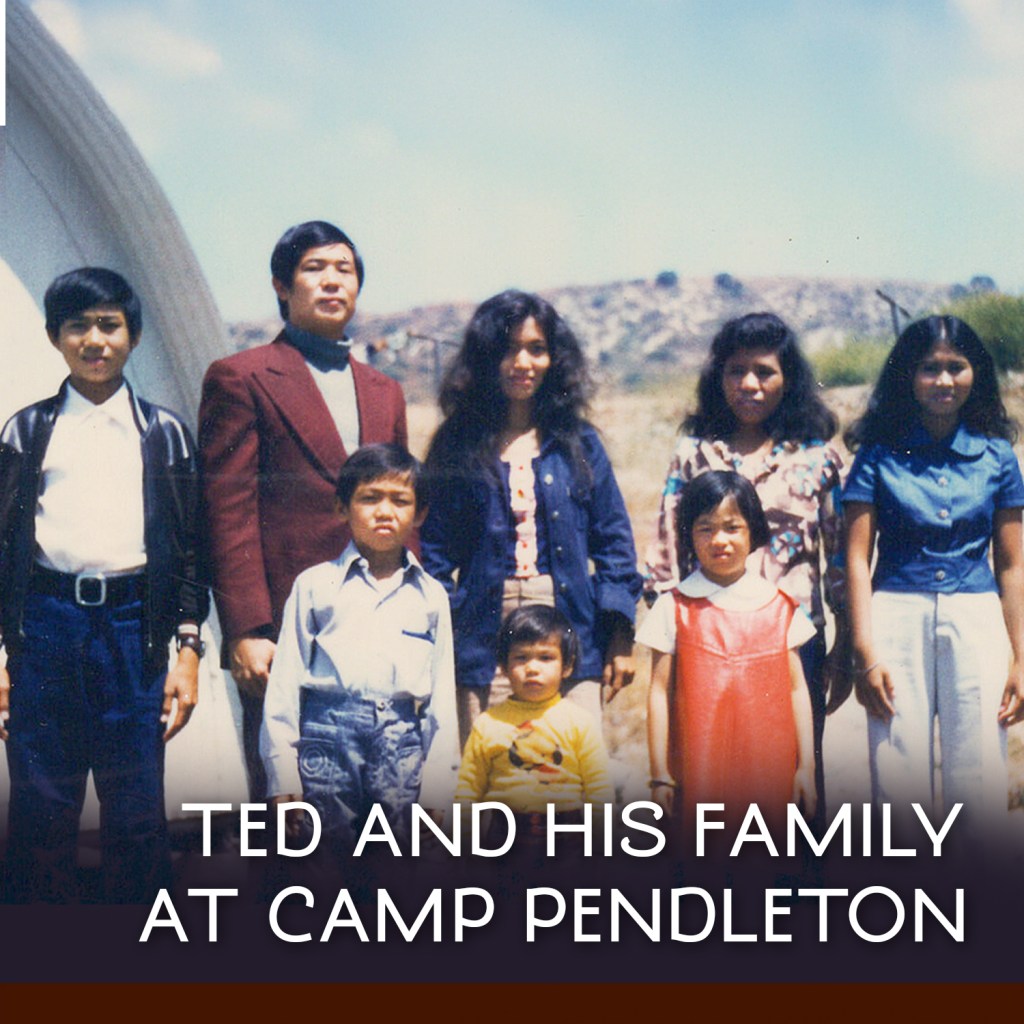
Ted grew up poor. His father left when he was young, so his mother raised him and his sisters alone. They lived in a single-room wooden house. Ted is used to hardship, but after experiencing success in Cambodia, it’s hard to start again from scratch.
Ted’s English is limited and he has very few connections in the States, but he’s willing to work hard. A church in the area offers to sponsor Ted and his family. That means they can move off the military base and get a home and a job in the community. The church pays the rent for the house where Ted and his family lives. They also help him get a job. First, Ted works at the church, cleaning and maintaining the grounds, but even with the church covering their rent, Ted isn’t making enough money to provide for his family.
A man named Dean, who’s an official at the church, takes an interest in Ted. He helps Ted get a second job at a gas station. Ted starts working nights at the gas station while still working at the church during the day. It won’t be the last time Ted will sacrifice sleep in order to get ahead.
Many nights at the gas station are slow. Sometimes, hours pass without a single customer. Ted begins to develop a friendship with a fellow employee named Andy. Ted and Andy talk, which gives Ted a chance to improve his English and learn about the culture of his new country. One slow night at the station, Andy asks Ted, “Ted, have you ever had a doughnut?”
The puzzled look on Ted’s face tells Andy all he needs to know. He goes across the street to a local doughnut shop and returns with a box of doughnuts. Ted tries one, then, in the morning, he buys a box of his own to bring home for the kids. Pretty soon, doughnuts are a weekly staple in his home.
He also starts to notice that doughnut shop across the street. Business seems to be booming and Ted has a businessman’s mind. He decides he wants to run a doughnut shop. A local doughnut chain called Winchell’s has a management training program. Ted decides he wants in, but without a US education and with his broken English, he’s unsure if they’ll accept him. He asks Dean to go with him to meet the regional manager. Dean agrees. He gives Ted a glowing recommendation, then when the manager asks, “Do you guarantee this man is responsible and that he will be a good employee for Winchell’s?” Dean tells him, “I guarantee it.” So Ted gets into the program. He learns the ins and outs of the doughnut business: keeping the books, cleaning the store, interacting with customers, and, of course, making great doughnuts.
He completes the program and gets his own store to manage. That doughnut shop consumes his life. He sleeps very little, spending all his time managing supplies, prepping ingredients, making doughnuts, and serving customers. It becomes a family endeavor. His wife helps him run the shop and his youngest son often falls asleep on the flour sacks in the kitchen while his father prepares the doughnuts.
Ted enjoys the business and learns a lot, but he doesn’t want to settle for running a shop for Winchell’s. He wants his own doughnut shop. He hears about a doughnut shop called Christy’s. The owners are ready to retire and they’re looking for someone to buy the shop. Ted pays them a visit. The shop is old and some of the equipment is out of date, but they have a good core of loyal customers and Ted is confident he can grow the business. So, he buys the store and with all he has learned, he quickly improves it. He’s careful not to alienate the existing customers by making big changes, but by cooking more batches of doughnuts during the day and using higher-quality ingredients, he ensures that the doughnuts are always fresh and always delicious. He delights his customers and the smell of doughnuts cooking draws in more people. After all, who can resist the smell of fresh doughnuts? Soon, the store is booming and he’s looking for another store to buy.

The next doughnut shop Ted buys is in a better location and it brings in a lot more business. He approaches another Cambodian family about running Christy’s so he can devote his attention to the new store. Like many Cambodian refugees, they are eager for work and they readily agreed. Without realizing it, Ted has created a pattern that he will repeat dozens of times.
Ted buys another shop, and then another. He’s a natural businessman and what began as one small doughnut shop quickly turns into an empire. As Ted expands, he provides more and more jobs for his Cambodian friends and family members. Running a doughnut shop is hard work, but Ted is a good boss and he’s happy to help those who are running his stores.
Pretty soon, Ted is a legend in the Cambodian-American community and he loves it. Being able to experience financial success and help his fellow countrymen at the same time is deeply rewarding. Pretty soon, it seems like there are Cambodian-run doughnut shops everywhere. Ted owns dozens of stores in the LA area. Later, nationwide doughnut chains will struggle to gain a foothold in southern California because of all the independent doughnut shops. If you can blame one man for that phenomenon, it’s Ted Ngoy. No wonder they call him the “Donut King”.
Life is good for Ted Ngoy. He’s rich. He’s successful. He’s helping others. It seems that he had found his calling. Ted Ngoy is living the American dream.
But it’s not going to last.
To hear the rest of Ted’s story, you’ll have to wait until next episode, but until then, let me give you some food for thought.
The man on the side of the road is bloody, he’s bruised, he’s on the narrow brink between life and death. Without someone to help him, he’s hopeless. But it’s not easy helping a half-dead man. He needs a medical professional or at least someone with a rudimentary understanding of first aid. The first two men to see the man in need are religious professionals. They don’t know how to clean a wound or set a broken bone and with no way to call for help they pass by. Maybe, hopefully, someone more qualified will come along.
The next person to see the wounded man is just a simple traveler. He has means of transportation and some basic supplies, but he’s not trained for this. Still, he stops and does his best to clean and bandage the man’s wounds, then takes the man to a place where he can rest and recover. It takes time, it takes money, and surely the man is sweaty and and covered in blood by the time the ordeal is over, but he saved a life. Still, he’s not looking for gratitude. He’s just trying to be a good neighbor.
When Jesus told the story of the Good Samaritan, He taught a valuable lesson. The man who challenged Jesus asked him, “And who is my neighbour?” (Luke 10:29). He wanted to know who falls within the boundaries of the people for whom I should take responsibility. Sure, I need to care for my family, I need to care for those who live closest to me, but how far out does the circle go? When is someone no longer my neighbor and, therefore, no longer my responsibility?
Jesus turned the question around and, at the end of his story, asked, “Which now of these three, thinkest thou, was neighbour unto him that fell among the thieves?” (Luke 10:36) You see, a neighbor is not someone who is looking for excuses not to help. A neighbor is someone who is looking for opportunities to help.
Ted Ngoy says in his self-published memoir that he owes a lot to Dean and other members of that church in southern California. Their kindness made a big difference for him and his family. I don’t know Dean and I don’t know what motivated him, but it would have been easy for Dean to think that a Buddhist refugee family from Cambodia was not his responsibility. Instead, Dean he saw an opportunity to help, and he took it. He went out of his way to help a man in need, even though that man was from the other side of the world.
None of us is responsible to meet the needs of the whole world, but if we’re going to be like Christ, we will keep our eyes open to the needs that we become aware of, even if those in need don’t seem to be our neighbors.
Proverbs 3:27 tells us, “Withhold not good from them to whom it is due, when it is in the power of thine hand to do it.”
We can’t help everyone, and different people need different sorts of help, but let’s not be too quick to make excuses for why a particular need is someone else’s responsibility. Otherwise, we’re acting a whole lot more like the religious leaders in the story of the Good Samaritan and a whole lot less like Christ.
A little kindness can go a long way.
Learn More
Ted’s Memoir (Amazon)
Articles about Ted (californiasunday.com, latimes.com, rafu.com)
 Exempla