
Abishai will do anything for his Uncle David. Just like his brothers Joab and Asahel, Abishai is an amazing warrior, he’s a bit of a hothead, and he is fiercely loyal.
One time, Abishai was with David outside David’s hometown of Bethlehem. The town was occupied by enemy forces, too many for David and his small band of warriors to take on. But David looks towards the town where he grew up and says to his followers “Oh that one would give me drink of the water of the well of Bethlehem, that is at the gate!” (1 Chronicles 11:17)
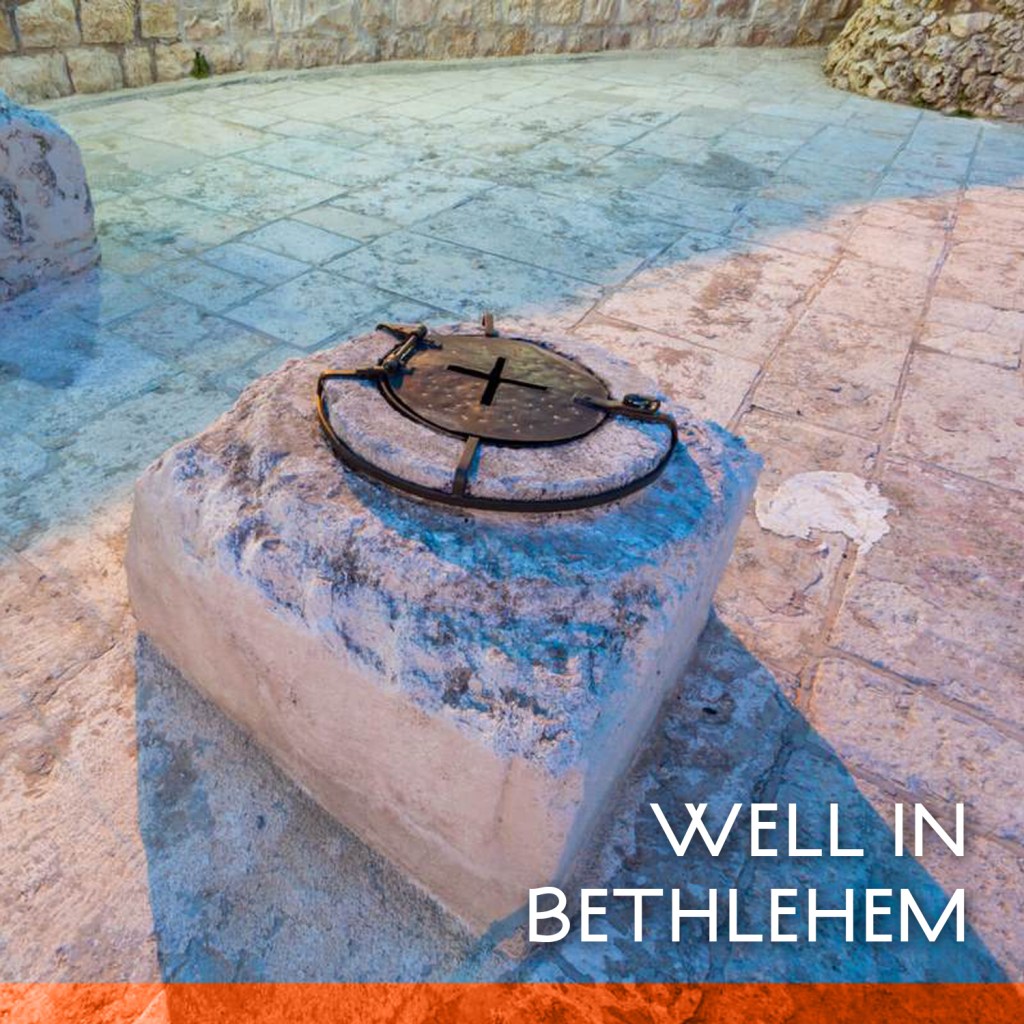
It’s probably just a throw-away comment, the daydream of a homesick man. But before you know it, Abishai and two other members of David’s band fight their way into the city, draw water from the well, and fight their way back out to deliver the water to David. These guys would do anything for their leader.
Abishai is there for David no matter what and that’s good right now, because this is a rough time in David’s life. David is on the run for his life. There’s a madman trying desperately to kill him. And the worst thing about is: that madman is the king of Israel.
Saul began well. He was a humble man, very aware of his own limitations, reluctant to accept responsibility for the entire nation. But… as time passes, Saul’s confidence grows. Sadly, Saul’s confidence begins to turn from God to himself. He famously ignores a direct command from God through Samuel, choosing to treat the nation of Amalek as he sees fit rather than as God commands. God’s prophet Samuel tells Saul that God has rejected him and Samuel goes to anoint a young man named David as king instead.
After this rejection, Saul’s life goes into a downward spiral. He becomes moody and violent, suspicious and angry.
One day, as David is playing music for the king, without warning, Saul throws a spear at David, trying to pin him to wall. Luckily David escapes, but it’s a sign of things to come.
Saul has decided that David is dangerous and there is only one thing to be done. He will see to it that David is killed. This obsession becomes the driving force of Saul’s life.
David goes on the run.
This game of cat and mouse becomes the pattern of life for these two men. David travels from place to place with his little band of men while Saul chases after him with thousands of soldiers.
Saul has gone from being a king who commanded great respect to the shell of the man he once was. He’s probably been king for decades now but he no longer deserves the honor of his people. Instead of leading them in honoring and worshipping God, he is too busy battling his own demons. Instead of protecting them from their enemies, he is taking the Israelite army into the wilderness to chase an innocent man. Talk about a washed up king. It’s definitely time for a regime change.
Now, this madman king has followed David into a hilly, rocky area called Ziph. He sets up camp with his army of 3,000.
David hears that Saul is close by and he goes to scout it out, then he gathers his men and asks for a volunteer for a dangerous mission.
“Who will go down with me to Saul to the camp?” (1 Samuel 26:6)
Abishai’s hand shoots up. “I will go down with thee.”
So, that night, David and Abishai head down to Saul’s camp. They find Saul and his entire army asleep. King Saul is in the center and all 3,000 soldiers are camped around him, presumably to protect him from the bloodthirsty David. David and Abishai are able to silently sneak right into the camp. And here is King Saul—David’s greatest enemy—lying asleep with his speak stuck in the ground.
Maybe, it is this very spear that Saul once threw at David, trying to pin him to the wall of the palace. Now, here it is. It seems like an invitation.
Abishai is over the moon.
He says to David, “God hath delivered thine enemy into thine hand this day: now therefore let me smite him, I pray thee, with the spear even to the earth at once, and I will not smite him the second time.” (1 Samuel 26:8)
Abishai wants to take Saul’s spear out of the ground and use Saul’s own spear to kill with a single stroke.
It seems like a great idea. Saul is a horrible king. He has turned his back on God. He’s no longer leading the people right. Someone needs to get rid of him. Surely, God has arranged this situation so David and Abishai can quickly and easily assassinate the king and David can take the throne.
But David responds. “Abishai, Destroy him not: for who can stretch forth his hand against the LORD’s anointed, and be guiltless?… As the LORD liveth, the LORD shall smite him; or his day shall come to die; or he shall descend into battle, and perish. The LORD forbid that I should stretch forth mine hand against the LORD’s anointed”. (1 Samuel 26:9-11)
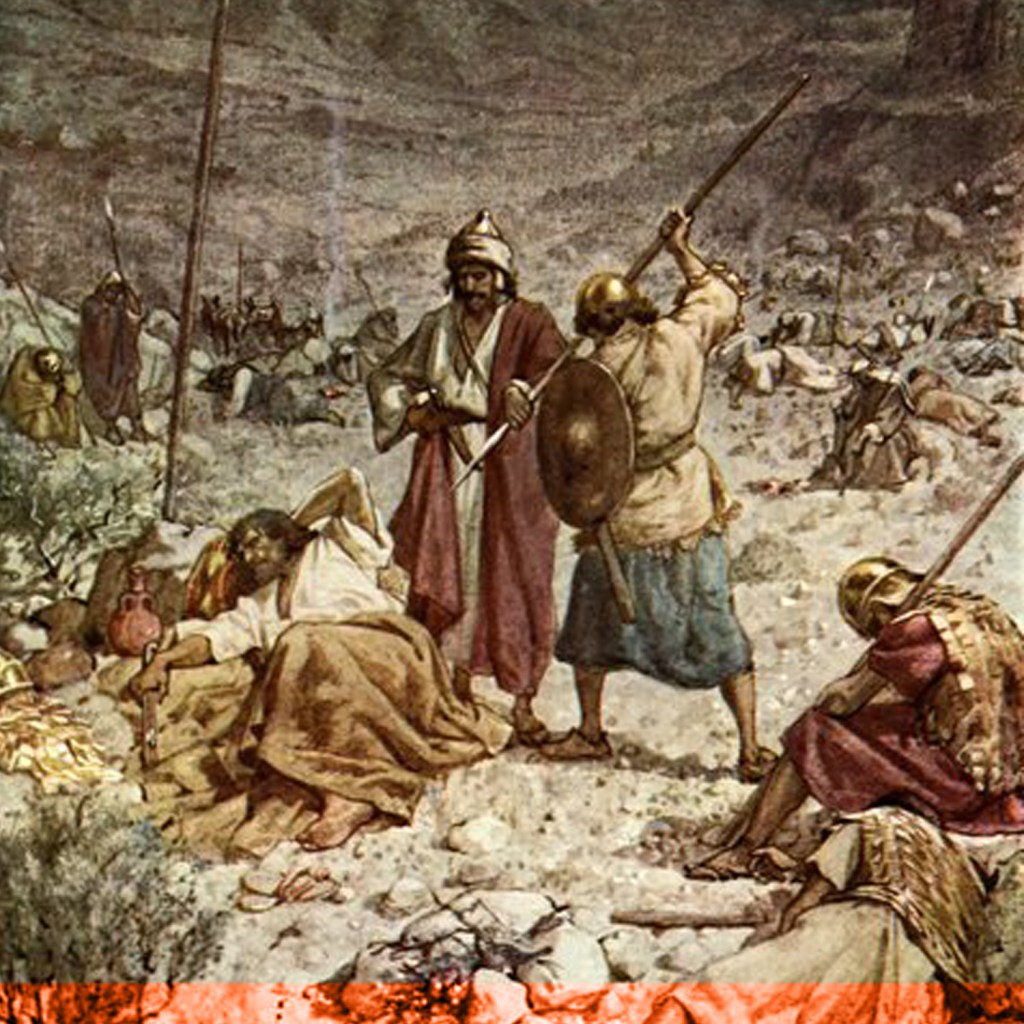
David won’t let Abishai lay a finger on Saul. All David and Abishai do is take Saul’s spear and a container of water that is right there next to Saul. Then they sneak back out of the camp and call back to the Israelites. David holds up the spear and the container of water so Saul will know that David could have killed him and chose not to. David pleads with Saul to be reasonable and he says, “The LORD render to every man his righteousness and his faithfulness: for the LORD delivered thee into my hand to day, but I would not stretch forth mine hand against the LORD’s anointed.” (1 Samuel 26:23)
Abishai and David were both faced with the same opportunity. Abishai wanted to seize that opportunity to remove an enemy and a bad ruler. David refused to take that opportunity, unwilling to touch the man he referred to as “the LORD’s anointed”. Saul was a horrible man and an awful king and yet, David treated him differently from how he treated any of his other enemies. David had no problem killing Goliath. He killed his fair share of enemies in battle. But he would not lay a finger on the King of Israel.
In Acts 23, Paul appears before the Jewish leadership and he is given the opportunity to give an account of himself.
He begins, “…Men and brethren, I have lived in all good conscience before God until this day.” (Acts 23:1)
That’s as far as he gets because the high priest Ananias commands that someone strike Paul in the mouth.
That, understandably, makes Paul mad and he shoots back, “God shall smite thee, thou whited wall: for sittest thou to judge me after the law, and commandest me to be smitten contrary to the law?” (Acts 23:3)
Fair enough. But they respond, “Revilest thou God’s high priest?” (Acts 23:4)
Suddenly, Paul goes from anger to apology, “I wist not, brethren, that he was the high priest: for it is written, Thou shalt not speak evil of the ruler of thy people.” (Acts 23:5)
Was it right that the high priest would order them to punch Paul in the mouth? Absolutely not! Was that high priest worthy of Paul’s honor? No. And yet… Paul is careful not to defend his quick words when he realizes he was directing them towards the high priest—the God-ordained religious leader in Israel.
Why did it matter to Paul? Why was he so careful? He tells us why in Romans 13. There, Paul says, “Let every soul be subject unto the higher powers. For there is no power but of God: the powers that be are ordained of God. Whosoever therefore resisteth the power, resisteth the ordinance of God: and they that resist shall receive to themselves damnation… Wherefore ye must needs be subject, not only for wrath, but also for conscience sake… Render therefore to all their dues: tribute to whom tribute is due; custom to whom custom; fear to whom fear; honour to whom honour.” (Romans 13:1-7)
What is Paul saying? He is saying that the high priest was put there by God. David was telling Abishai the same thing—King Saul was put there by God. But Paul is also making it clear that this goes beyond just the king of Israel or the high priest in Jerusalem. He is extending this to every authority: “there is no power [no authority] but of God”.
Why, David? Why stop Abishai? Because God put Saul where he was. Like it or not, he’s the king of Israel and David and Abishai both need to respect that. God sets up kings and takes them down at will. It’s not David’s job to do God’s job for Him. Nor does David get to choose whether or not he ought to respect God’s choice of king. His responsibility was to respect the authority God had put in place, even when that authority was unbelievably corrupt and inexpressibly unworthy of that respect.
Many of us have an opportunity that David and Abishai did not have. We get to engage in a civil process where our voices are heard in choosing who will be the leaders in our country. That’s a very special privilege and one we should treasure. But that does not mean we are in any way free from the responsibility that David and Abishai had.
Look at any political candidate and you’ll probably find excuses to disrespect them.
My challenge is this: in a nation that has forgotten how to respect her leaders—let us, as Christians, be different.
God doesn’t command us to be excited about who is in authority, but He does command us to respect them—to give fear to whom fear is due and honor to whom honor is due.
You may find it easy to respect our elected officials. Or, you may not. But let us, as Christians, be the first to say that no matter who holds the presidency, who represents us in Congress, who is the mayor of our city, and who is on our school board, we are going to treat them with honor and respect—not necessarily because they deserve it, but because God, in His infinite wisdom, has chosen to put them right where they are.
If David can respect a madman who is trying to kill him even though he’s innocent, we too can show respect for our leaders—even if we disagree with them, even if we desperately wish that God would remove them and replace them with someone better.
We have an opportunity, as believers, to stand out from the culture around us because of the respect we show for those in authority. Because unlike the unsaved people around us, we recognize that there is no authority that is NOT God-given. Every authority figure in all the world has been gifted that authority by God.
So, let’s look past them to the God who gave them their authority and respect and honor them for His sake.
 Exempla