Over the summer, I’m replaying some favorite episodes of Exempla from the first season. If you’re unclear on what “Exempla” means or why the podcast has that name, this episode is for you. In this replay of the very first episode of the podcast, I explain the origin of the show and its unusual name and I talk about why storytelling is so important. First aired on November 10, 2021, here’s “My Exempla”. Enjoy.
It was a normal Sunday at my church. As we do once every month, we were sharing the Lord’s Supper, something I have done… I don’t know know how many dozens of times before.
But one thing was different this time. I was struck by the meaning of the occasion in a way I never really had been before. See, it certainly wasn’t my first time, but it was the first time my son had been there to watch the Lord’s Supper.
I watched his face as trays with small pieces of bread and tiny cups were passed up and down each row and I saw a question in his eyes.
Why?
Kids are curious and when they notice something different, they wonder why. They’re going to notice when we start passing out bread and juice in a church service. Whether or not they voice the question, they’ll wonder, Why is this service different from the others? Why are we doing things this way this time?
That night, as my son’s eyes followed those silver trays, I looked at that age-old tradition with fresh eyes and my mind went back to the foundation for the Lord’s Supper.
Of course we know that Jesus Christ himself instituted this memorial meal with his disciples, but its original source goes back even further. The bread and the wine that Jesus lifted as He said, “this is my body” and “this is my blood” were part of the Passover feast.
On the Friday night before Easter each year, Jewish families around the world gather to share a very special meal. Seder, which is the meal that kicks off the Passover, is full of symbolism and tradition. Special foods are eaten, unique rituals are followed, and specific words are recited at certain times. At one point in the meal, tradition calls for the youngest person at the table to ask a question.
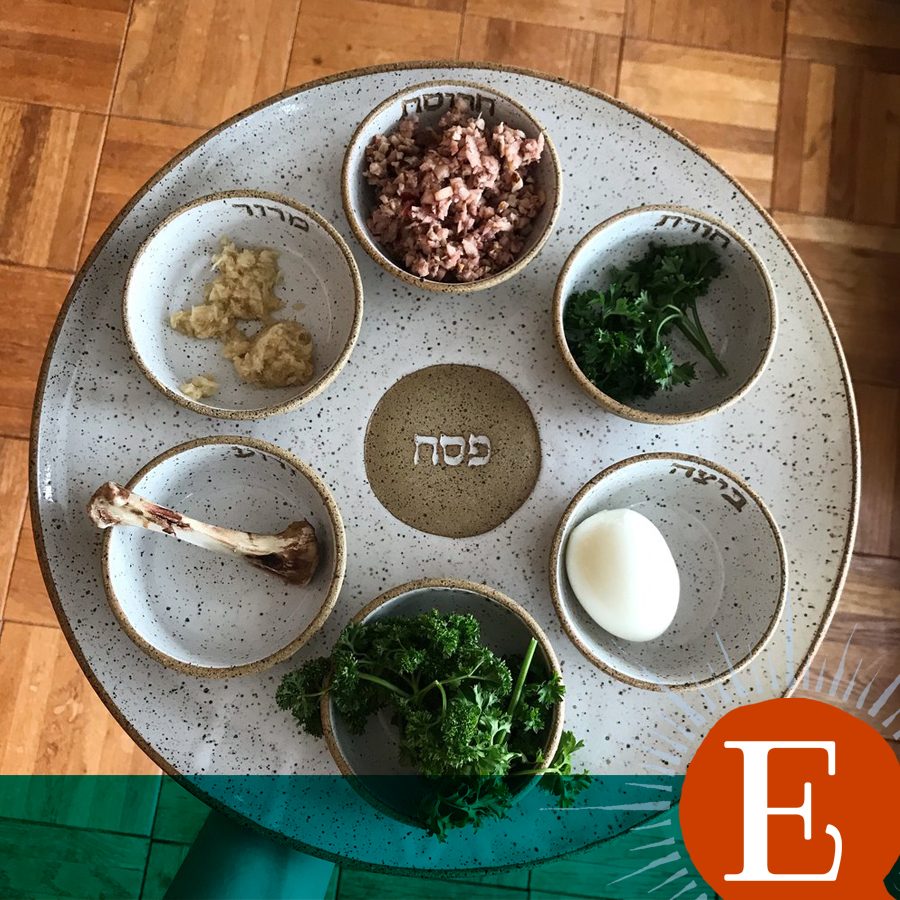
Ma nishtanah halailah hazeh mikol haleilot? (Or something like that.)
It is a natural question for the youngest person at the table to ask. Roughly translated, it is: What makes this night different from all other nights?
They’re eating different food. They’re practicing ceremonial hand washing. They’re saying things and doing things they wouldn’t normally do when they eat together as a family. And what’s the natural result? A kid is going to pipe up and ask why.
The answer comes in the form of a story. The patriarch of the family responds to the child’s question by saying, “We were slaves to Pharaoh in the land of Egypt. And the Lord, our God, took us out from there with a strong hand and an outstretched arm.”
Over time, the celebration of Passover has changed in some ways as the holiday has grown from its Biblical foundation, but that child’s question and its answer find their roots deep in God’s initial instructions for the Passover feast.
After telling His people how to prepare the lamb and how to eat the meal and why the bread should be unleavened, God said this: “…ye shall observe this thing for an ordinance to thee and to thy sons for ever. And it shall come to pass, when ye be come to the land which the LORD will give you, according as he hath promised, that ye shall keep this service. And it shall come to pass, when your children shall say unto you, What mean ye by this service? That ye shall say, It is the sacrifice of the LORD’s passover, who passed over the houses of the children of Israel in Egypt, when he smote the Egyptians, and delivered our houses…” (Exodus 12:24-26)
God intentionally built the feast of Passover so that kids would ask why. And when they asked, He told His people not to give a sermon, not to give a lesson, but to tell a story.
And the book of Exodus clearly tells us that thrilling story. We see Israel in bondage and we see God bringing them to freedom. The story reminds us of God’s power and it reminds us of the importance of listening to what God says. God wanted His people to remember those important lessons. He wanted each generation to look back and remember what God had done for Israel and He knew that storytelling was the most effective way to accomplish that objective.
God recognizes that stories have power. He knows that truth communicated through a story carries a special kind of weight. That’s why He built stories into the very framework of Jewish culture.
When God wrote us a book, He filled it with stories.
The Bible tells us about God, about ourselves, about how life really works. It gives us God’s perspective. And when you start reading it, what do you find? It’s in story form.
We have the story of Creation. We have the story of the Fall. We have the story of Abraham and of Isaac and of Jacob. We have the story of the people of Israel coming out of Egypt and God uses these stories to teach us deep and abiding truths. But even the most didactic parts of Scripture are accompanied by stories and illustrations.
Jesus himself, the best teacher ever, used stories all the time—the story of the Prodigal Son, the story of the Good Samaritan, all the parables…
If God so consistently uses stories to communicate the truth, shouldn’t we do the same?
Exemplum is the Latin word for example. But in Medieval times, it took on a special meaning. Preachers of the day would incorporate fables and legends into their sermons and they called each illustrative story an “exemplum” and a compilation of such stories was called an “exempla”. Some preachers even published their “exempla” for the benefit of others.
This is my exampla. I want to compile and tell stories that help people understand God’s truth. The Bible is the source of all truth, but I believe that helpful stories can come from literature, from personal experience, from history, and even from our own imaginations.
I am grateful for writers in history like John Bunyan and C. S. Lewis who embraced that idea for our lasting benefit.
This podcast is all about bringing people face-to-face with the truth. I hope that the stories I share and their Biblical application will cause you to consider eternal truths in new and compelling ways. I also hope these stories will inspire you to embrace the power of stories. Whether you’re a parent, a Bible teacher, a preacher, or just somebody who wants to be a good friend and a good influence on others, you can use stories to challenge others with God’s truth.
As I sat in the auditorium that day and watched my son’s eyes scanning back and forth, I was reminded of the value God places on the pictures and stories that are a part of our lives.
I am excited in the days to come to be able to answer the questions in my son’s mind. As he grows in understanding, I can’t wait to more fully I explain to him what that cup and that bread really represent as I tell him the incredible, life-changing story of Jesus.
Learn More
About the Passover Seder meal: myjewishlearning.com & sefaria.org
 Exempla