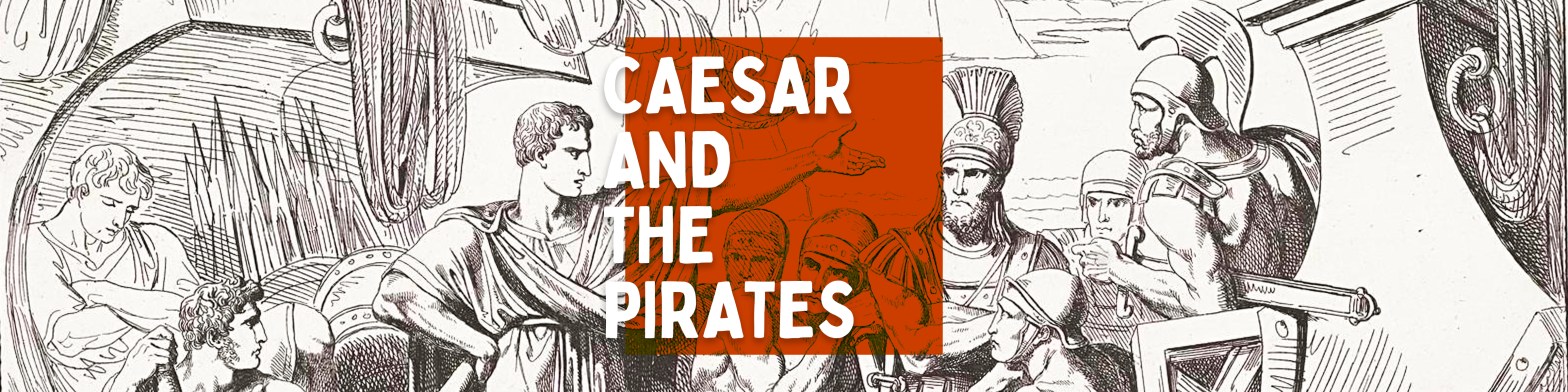
A young Roman nobleman named Julius Caesar is on his way to the island of Rhodes. There, he plans to study under a man named Apollonius Molon, a man renowned for his wisdom in the area of rhetoric. Caesar is not yet well-known in Rome, but he is eager to broaden his influence and he knows it will help if he develops his oratorical skills.
It’s a beautiful day on the Aegean Sea as Caesar approaches his destination. Then, a ship appears and begins to sail towards the vessel bearing Caesar and his entourage.
As the mystery craft approaches, it begins to dawn on the crew of Caesar’s ship that they are about to be boarded by pirates.
Pirates are a serious problem in this part of the Mediterranean. Cargo ships that dare these waters are often boarded. Any ship that is slow-moving and not well-armed is a tempting target. Captives of the pirates are often sold as slaves, but if the pirates are lucky enough to nab a nobleman like Julius Caesar, they will hold him for ransom.
The pirates easily overtake and board Caesar’s ship.
Julius Caesar is a prisoner to pirates.
But this isn’t Caesar’s first rodeo. Four years ago, when he was just twenty-one years old, Caesar was held for ransom by pirates. He paid them the twenty-five talents of silver they demanded. He returned home from the experience a little poorer, but none the worse for wear.
This time, the pirates once again demand a ransom, but they only ask for twenty talents of silver.
Caesar laughs in their faces.
You must not know who I am. You ought to demand far more than twenty talents of silver for MY ransom. In fact, I won’t settle for paying you less than fifty.
Caesar sends his servants off to raise the inordinate amount of cash. Fifty talents of silver is more than 1,000 pounds of precious metal, but Caesar seems unconcerned. As he waits for his money, he makes himself at home.
For over a month, Caesar lives among the pirates. They have stolen his freedom from him, so he returns the favor. He behaves himself, not like a captive, but like an honored guest. He speaks to the pirates as if he is their master and they, his servants.
He joins in their activities and bosses them around. When he thinks they’re being too loud while he’s trying to sleep, he sends a servant out to tell them to stop talking.
To pass the time, Caesar works on his writing and speaking skills. After he writes a poem or speech, he demands that his captors listen to his eloquent words. He expects them to appreciate his oratorical genius and if they fail to applaud him for his speeches, he mocks them as “illiterate savages”.
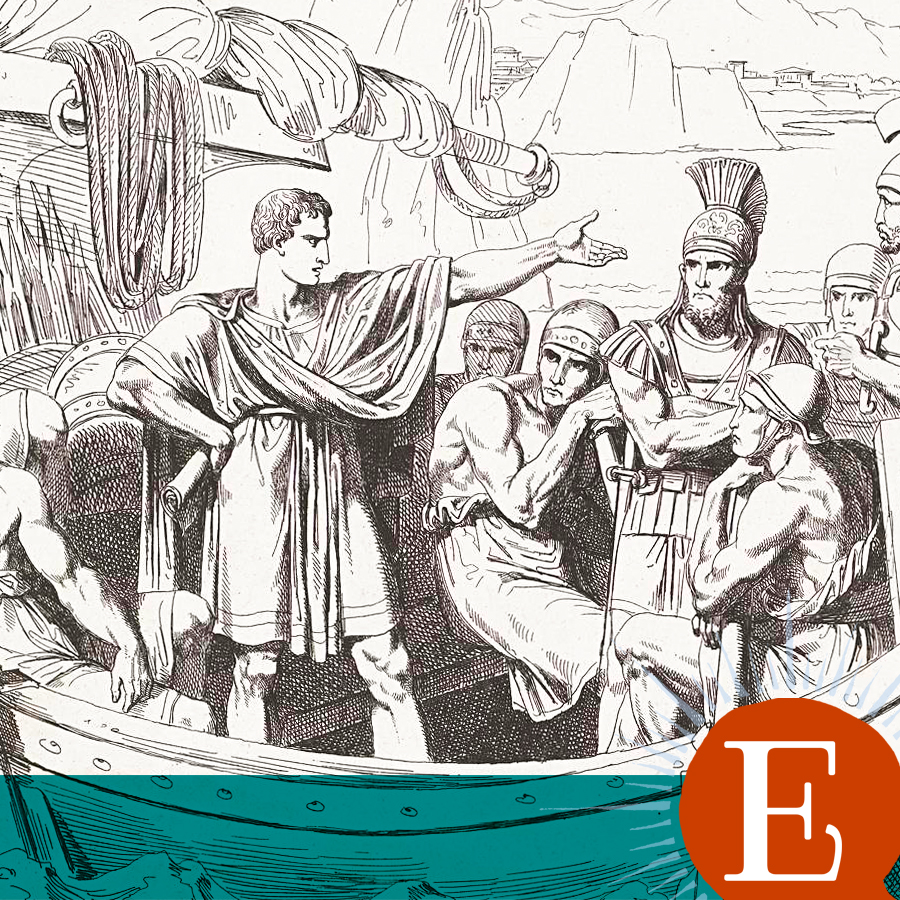
Amid his flurry of speeches, Caesar also threatens to have his captors put to death.
Most of the pirates have concluded that Caesar is crazy, so they don’t give it a second thought.
Finally, the fifty talent ransom arrives, and the pirates are set free from their tyrannical captive. They surely breathe a sigh of relief, grateful for the windfall and equally grateful that they won’t see Julius Caesar again. No more speeches.
But perhaps they should have taken their prisoner’s words more seriously.
Upon regaining his freedom, Caesar promptly raises a small navy in the nearby town of Miletus, and returns to the island where the pirates are anchored. He easily overpowers the pirates with his superior force, and he takes back his fifty talents of silver along with the rest of the pirates’ belongings. The plundered pirates are put in prison and Caesar demands that they be put to death for their crimes.
The governor is reluctant, so Caesar takes charge and personally oversees the pirates’ execution. Only too late do the pirates learn that Caesar is not a man to be trifled with.
Outnumbered and outarmed, Caesar still managed to steal the show. It seems he could take charge of any situation. Julius Caesar understood something very important—it is words, more than weapons, that rule the day.
One interesting aspect of the story of Caesar and the pirates is that it’s hard to know which details are fact and which are fiction. It’s possible that Caesar’s encounter with the pirates was much less dramatic than the version I’ve shared with you. It’s possible that he didn’t bend them to his will as readily as some accounts suggest.
But Caesar himself got to decide how the story was told. He chose to tell the story in a way that portrayed him as a man who could take charge of any situation. Caesar’s encounter with pirates in the Aegean became part of the myth of the larger-than-life figure he became.
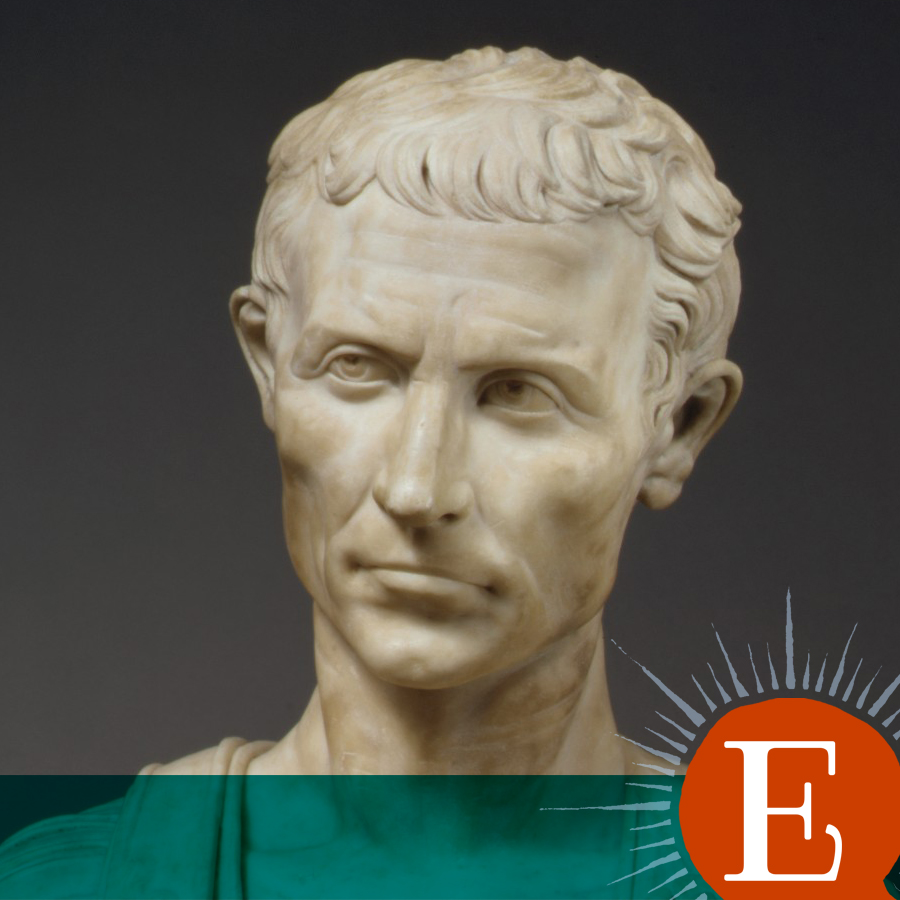
Caesar knew that the stories told about him and the way those stories were told would have a serious impact on his ability to rise in power and influence. He wanted everyone to know that the pirates were stronger, but he was smarter.
Who doesn’t want a leader like that?
Time goes on. Caesar gets his speech lessons in Rhodes, he continues to practice his speeches, and he uses his eloquence to rise to power in Rome. The higher his rises, the clearer it becomes that Julius Caesar wants to rule.
Many are deeply disturbed by Caesar’s readiness to become the king of a traditionally republican government. More and more, they see him as a threat that must be eliminated.
They decide that Julius Caesar must be silenced.
In a famous chapter of Roman history, Caesar’s fellow senators draw their daggers and kill this man who would be king. No more will Caesar be able to use his golden tongue to shape the destiny of Rome.
The daggers win the day. Rome is free of her threat.
But time tells a different story. Julius Caesar’s nephew Octavian also understands the importance of words. Like his uncle, he knows how to use his rhetorical skills to rise in power. In time, Octavian becomes Augustus Caesar—the first emperor of Rome—a man so revered by his fellow Romans that they worship him as a deity.
In striking down one ruler, Caesar’s opponents inadvertently made way for another Caesar, one who would become even more powerful than his uncle would have dreamed.
The Roman senators knew how to wield their daggers, but Caesar knew how to wield his words.
King Ahab is grumpy. He asked nicely, but Naboth said no. Naboth has a beautiful vineyard right next to Ahab’s royal palace and Ahab really wants to have Naboth’s vineyard. He offered to get Naboth another vineyard or even to buy Naboth’s vineyard outright, but Naboth was clear: “The LORD forbid it me, that I should give the inheritance of my fathers unto thee.” (1 Kings 21:3)
Now Ahab is in bed, refusing to eat, throwing a fit because he didn’t get what he wanted.
Ahab’s wife Jezebel comes to check on him. When Ahab explains his predicament, Jezebel responds, “Dost thou now govern the kingdom of Israel? arise, and eat bread, and let thine heart be merry: I will give thee the vineyard of Naboth the Jezreelite.” (1 Kings 21:7)
Jezebel knows how to fix this problem. Ahab is king after all, but Jezebel knows the right way to get Ahab what he wants is not to send an army out to seize Naboth’s land. Sure, that would be effective. But there’s a better way.
Jezebel writes some letters. She uses her husband’s name to command the rulers of the city to put Naboth on trial. She tells them to get false witnesses to attest that Naboth has blasphemed God and dishonored the king.
It all happens according to Jezebel’s instructions. At Naboth’s sham trial, lying witnesses claim that, “Naboth did blaspheme God and the king” (1 Kings 21:13). Naboth is declared guilty, dragged out of the city, and put to death.
With Naboth out of the way, Jezebel tells Ahab to go get his vineyard.
Jezebel understood the power of words.
The Bible tells us in James 3 that “the tongue is a little member, and boasteth great things.” (James 3:5)
It also says that, “the tongue is a fire, a world of iniquity”. (James 3:6)
An English author in the 19th century coined the phrase, “the pen is mightier than the sword”, but the sentiment is far older. Three hundred years before Julius Caesar’s birth, the Greek playwright Euripides is quoted as writing, “The tongue is mightier than the blade.” Hundreds of years before that, God inspired King Solomon to write that, “Death and life are in the power of the tongue”. (Proverbs 18:21)
Men like Julius and Augustus Caesar and women like Jezebel have recognized and seized the power of the tongue. Many in history have used that power for good, many others have used it for evil.
You might not have armies at your command, you might not be very good with a sword, but you have a tool that has the power to shape history itself. Julius Caesar used his words to turn his captors into captives. Jezebel used her words to get rid of an inconvenient life. Do you understand the power of your words?
The tongue is “an unruly evil, full of deadly poison.” (James 3:8) Only God can tame the tongue.
Whether you like it or not, you are setting things on fire with your tongue. You are shaping your life and the life of others with the words you say.
Words are weightier than weapons.
What are you accomplishing with your words?
Learn More
About the Cicilian pirates (Livius.org)
About Caesar’s encouter with the pirates (Britannica.org & Livius.org)
 Exempla