
It’s bitterly cold. The wind off the water, the dark of the early morning, and the absence of any shelter on the small boat prompt John to wrap his coat more tightly around his body. But as the boat nears the town, John’s mind is not primarily on the cold. His mind is racing, thinking back over all that has happened in the last two and a half years since he was last in England. The more he ponders, the more thoroughly the cold, dark waves of despair wash over his soul.
At about 4:30 in the morning of February 1, 1738, John Wesley steps onto the pier in Deal, England and he feels utterly lost.
John Wesley had a strict and highly religious upbringing. His father was an Anglican rector. His mother, Susanna, was a very devout and careful mother. But upon going away to school, John began to wander from his strict Christian upbringing.
One evening, while studying at Oxford, the young John Wesley strikes up a conversation with an impoverished porter. It’s a chilly night and John encourages the man to go home for a warmer coat.
John is taken aback when the man says that the well-worn coat he is wearing is the only one he owns. He expresses gratitude to God for providing him with this thin garment. He goes on to give thanks to God for the cold water that has been his only sustenance that day and for the dry stones that will serve as his bed that night.
With disbelief in his voice, John comments, “You thank God when you have nothing to wear… nothing to eat… no bed to lie upon. I cannot see what you have to thank God for.”
With deep sincerity, the porter replies, “I thank God… that He has given me my life and being, and a heart to love Him, and a desire to serve Him.”
This level of commitment to and contentedness in God serves as a rebuke to John’s indifference. The simple conversation touches him deeply. He writes of the encounter, “I shall never forget that porter. He convinced me there is something in religion to which I am a stranger.”
John begins to pour himself into his studies, not just the academic regimen prescribed to him, but to personal study as well. He reads books about Christianity, he studies the Bible, he discusses matters of theology with friends and colleagues, all the while exchanging long letters with his mother Susanna. He does all this in search of a robust faith in God.
He creates rules for his life, which include,
“Begin and end every day with God; sleep not immoderately.”
“Employ all spare hours in religion, as able.”
and “Never on any account pass a day without setting aside at least an hour for devotion.”
John joins and becomes the leader of the “Holy Club”, a group of devout young men who want to encourage one another to live pious lives. Soon, they’re meeting for three hours daily, challenging each other to behave as Christians and providing each other with rigorous accountability.
It seems that if anyone at Oxford is a devoted Christian, it is John Wesley.

When the opportunity to minister in the new British colony of Georgia arises, John seizes it with high hopes. His plan is to preach the gospel to the native people—the American Indians. John has trained for the ministry at Oxford and seems well-prepared for the task. He hopes to have a profound effect on the new colony. He dreams of natives flocking to hear him preach and converting to Christianity in droves.
On their way to Georgia, John and his travel companions keep themselves to a strict schedule. They rise at four o’clock each morning, then spend an hour in private prayer. Following prayer, they spend two hours in joint Bible study before breakfast. Each day features other times of prolonged Bible study, more time spent in prayer, and an hour-long service each evening.
But the Georgia of reality does not live up to John’s dreams. John finds himself mostly visiting and preaching to the cold-hearted European colonists. With his dour preaching and strict standards, John manages to make enemies everywhere he goes. In the end, relationships sour to the point that John has to flee Georgia and finds himself on a ship headed back to England.
On the long passage back to England, more torments John than just his failure to singlehandedly transform Georgia. Doubts and questions nag at his heart. There is something wrong that is far more significant than a single ministry misstep.
Even with all his strict Christian practices and outward religion, John realizes something is wrong.
As he crosses the Atlantic after his failure in Georgia, John writes, “I went to America, to convert the Indians; but oh! who shall convert me? who, what is he that will deliver me from this evil heart of mischief? I have a fair summer religion. I can talk well; nay, and believe myself, while no danger is near; but let death look me in the face, and my spirit is troubled.”
Upon arriving back in England, he writes, “It is now two years and almost four months since I left my native country, in order to teach the Georgia Indians the nature of Christianity: But what have I learned myself in the mean time? Why (what I least of all suspected), that I who went to America to convert others, was never myself converted to God.”
Others looking at John’s life see an upstanding exemplary Christian. John, looking at his own heart, sees the sinful truth.
About a week after his return, John meets a man named Peter Bohler. As weeks turn into months, John and Peter have many long talks about Christianity.
Peter pleads with John, “My brother, my brother, that philosophy of yours must be purged away.” Again and again, he seeks to communicate with John the nature of true living faith. He tries desperately to help John understand the simple and overwhelmingly important fact that salvation is by grace alone. But John is so entrenched in his Christian practices and so convinced that being a good Christian is all about a certain kind of performance that it takes months for the simple message to truly take root.
Then comes May 24, 1738.
“I think it was about five this morning,” John says in his journal, “that I opened my Testament on those words, ‘There are given unto us exceeding great and precious promises, even that ye should be partakers of the divine nature’ [2 Peter 1:4]. Just as I went out, I opened it again on those words, ‘Thou art not far from the kingdom of God.’ [Mark 12:34]”
God’s Word is having its effect.
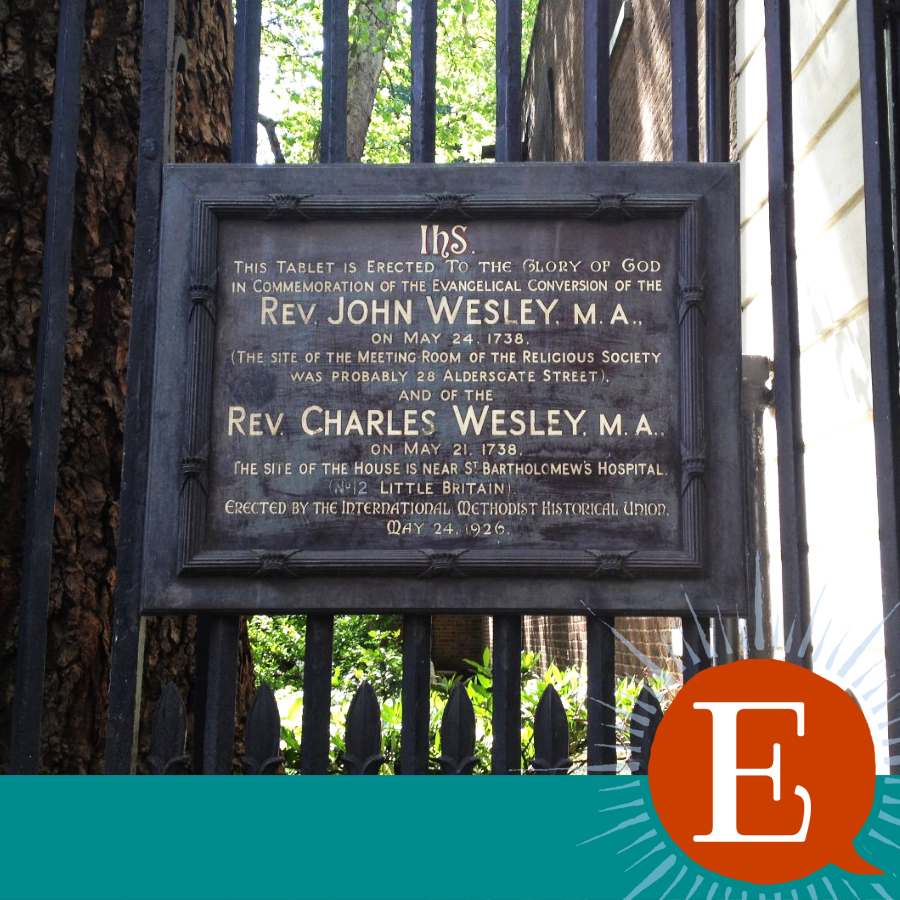
That evening, John attends a gathering at a meeting house on Aldersgate Street in London. Someone reads from Martin Luther’s Preface to the Epistle to the Romans and John writes,
“About a quarter before nine, while he was describing the change which God works in the heart through faith in Christ, I felt my heart strangely warmed. I felt I did trust in Christ, Christ alone for salvation: And an assurance was given me, that he had taken away my sins, even mine, and saved me from the law of sin and death.”
Let me paint a picture for you. A kid grows up in a Christian environment. They attend church or a Christian school or both. They know how to talk and act like a Christian. But something changes. Maybe it’s when they graduate. Maybe it’s a slow withdrawal. Where their lives once seemed to revolve around Christian things, now it seems like church, and the Bible, and even God are only peripheral considerations at best.
It happens all the time and it always begs the question: what happened?
Whatever Christianity they had didn’t seem to stick.
In Matthew 7, Jesus gives a sobering warning about dead religion.
“Not every one that saith unto me, Lord, Lord, shall enter into the kingdom of heaven; but he that doeth the will of my Father which is in heaven. Many will say to me in that day, Lord, Lord, have we not prophesied in thy name? and in thy name have cast out devils? and in thy name done many wonderful works? And then will I profess unto them, I never knew you: depart from me, ye that work iniquity.” (Matthew 7:21-23)
There are people who are busy doing things in the name of God, declaring to everyone that He is their Lord who will one day hear Him say, “I never knew you”. All of their “wonderful works” are in God’s sight just all that much “iniquity” because though they profess His name, they do not truly know Him.
What if you met John Wesley in early 1738? You might have thought that he was odd, but if you’re like me, you probably would have looked at his devotion to Bible study and holy living, his willingness to travel across the sea to preach the gospel, his strict habits of life and would have concluded—John Wesley is not just a Christian, he’s a far better Christian than I am!
But the reality was that John Wesley was lost in his sin. He had religion, but he did not have eternal salvation. John Wesley did a lot of good works. Even after his salvation, he continued some of his strict habits of life for decades. But rising at 4:00 could do nothing to save John’s soul. Neither could beginning and ending every day with God or employing all spare hours in religion.
It’s not that religion is bad. There are lots of good religious people doing lots of good religious things. Some of them even know God. But looking like a Christian means nothing in and of itself.
As Ephesians 2 simply and powerfully states it:
“For by grace are ye saved through faith; and that not of yourselves: it is the gift of God: Not of works, lest any man should boast.” Ephesians 2:8-9
Salvation is by grace alone. No one is saved by anything other than the free gift of God.
You can look good for Christian friends, for people at your church, even for your own family. But looking like a Christian, acting like a Christian, even doing good Christian things and avoiding sin when no one is watching, though it may be admirable, does nothing to save your soul.
John Wesley was a role model among Christians, but he had to come to the simple and earth-shattering realization that he could be redeemed only by the grace of God. No amount of effort could get his soul any closer to God.
The good news is, salvation is by grace alone, so it is simple. It simply takes the humility to admit your sin and helplessness to save yourself and plead for the salvation that only Christ can give, casting yourself on the mercy of God.
And Jesus said, “him that cometh to me I will in no wise cast out.” (John 6:37)
Read from John Wesley’s journal, including the account of his conversion (Christian Classics Ethereal Library)
Read about John and the porter (Siloam Springs Herald Leader)
 Exempla