
Frank, Jim, and Bill were not going to make it home for Christmas. It was Christmas Eve 1968 and the three men were farther from home than they had ever been before. Truth be told, they were farther from home than any human being had ever been before. That’s because Frank Borman, Jim Lovell, and Bill Anders were astronauts – the crew of Apollo 8.
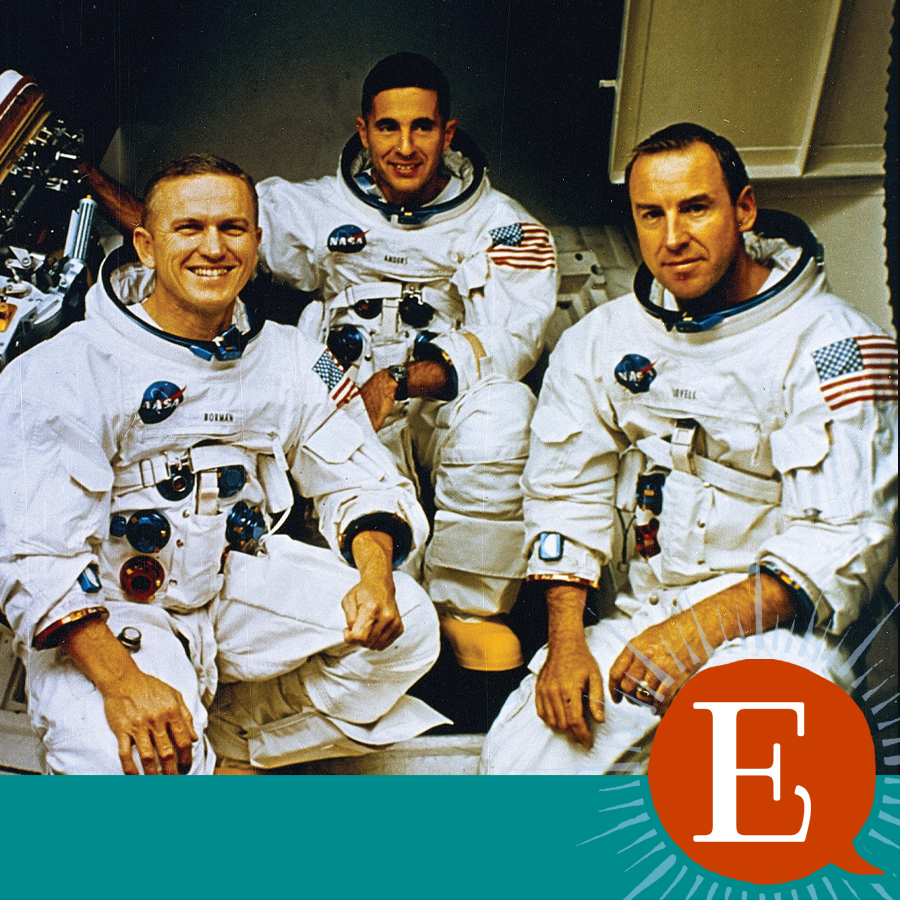
In 1968, the space race between the United States and the USSR was in full swing and so far John F. Kennedy’s promise to put a man on the moon “before the end of this decade” had gone unfulfilled. But Apollo 8, it was determined, would be the mission to keep that promise. Apollo 8 would feature a lunar module that would allow an American man to beat the Russians to the surface of the moon.
Borman, Lovell, and Anders would be the lucky men to man this historic mission. Then, the bad news came. The lunar module would not be ready until the following year, 1969. Apollo 8 would have to be postponed, but NASA decided otherwise. The crew of Apollo 8 might not be able to be the first humans to land on the moon, but at least they could be the first humans to make it to the moon. Apollo 8 would still depart on schedule in December of 1968. Instead of landing, the astronauts would orbit the moon in the command module, taking pictures and gathering data, paving the way for a future moon landing mission.
After a mere four months to prepare for the historic mission, on December 21, 1968, the three men boarded the spacecraft. The countdown, the launch, the successful exiting or earth’s atmosphere, and they were on their way.
The 240,000 mile trip to the moon took about three days and expectation built as the moon grew closer and closer. Then, on Christmas Eve, they reached the moon. They slowed and entered orbit, then as the spacecraft began to circle the moon, they caught sight of something never before seen by human eyes – the far side of the moon. Frank, Jim, and Bill sat silently as they drank in the sight, overwhelmed to be the first humans this close to the moon’s surface.

Then, as they rounded the moon, the men looked back and saw something even more awe-inspiring. They saw the earth, over 200,000 miles away. There had been pictures, but nothing like this. No human being had ever seen the earth from this distance. Jim Lovell recalls holding up his thumb and being able to cover up the earth. As the earth peeked out from behind the moon, Bill Anders snapped what would become the iconic “Earthrise” photo. The picture shows the curve of the moon’s surface with the blue and white ball of the earth off in the distance and it captured the imagination of the world.
It was both a solemn and exuberant experience for the astronauts. In a way, they were seeing more clearly than anyone before them what science was already telling the world. Earth is just a speck in a vast galaxy which is just a speck in a far vaster universe.
Despite the distance, the events on Apollo 8 were certainly not going unnoticed back on earth. All of America, it seemed, was paying close attention to the Apollo 8 mission. 1968 had been a red-letter year. Martin Luther King Jr. had been assassinated, as had Bobby Kennedy. The Tet Offensive in Vietnam had brought increased American casualties bringing an increase of opposition to US involvement in the conflict. America was divided and discouraged and everyone wanted some good news. They were looking to Apollo 8.
On Christmas Eve, there was a live broadcast from Apollo 8. Families all over the United States and across the world gathered around the 20-inch black-and-white TVs and eagerly awaited the broadcast from space.

Frank Borman recalls that they were told by NASA that they would have “the largest audience that had ever listened to a human voice”. Before the broadcast, NASA estimated one billion people would be watching. Borman says that, with that sobering fact in mind, NASA had instructed him and his crew to do “something appropriate.” No further instructions, just “something appropriate”. Borman, Lovell, and Anders were astronauts, not TV men, so the responsibility no doubt weighed on them. Their countrymen back home would be looking at the broadcast as much more than entertainment. They were looking for victory, for hope.
Crowded together in the Apollo 8 command module, the three men showed America and the world the surface of the moon. They pointed out landmarks, talked about what they saw, and explained features that weren’t clear on the grainy video. For nearly half an hour, they gave this guided tour of the moon. Then, the time came for the broadcast to close.
It was time for the “something appropriate” that would couch this mission in the right terms. It was time for Borman and his crew to tell America what this all meant and why they should take heart. What could possibly be said? What words could be enough?
Bill Anders signaled the beginning of the sign-off. He said,
“For all the people back on earth, the crew of Apollo 8 has a message that we would like to send to you.”
Then, he began to read.
“In the beginning God created the heaven and the earth. And the earth was without form, and void; and darkness was upon the face of the deep. And the Spirit of God moved upon the face of the waters. And God said, Let there be light: and there was light. And God saw the light, that it was good: and God divided the light from the darkness.”
Jim Lovell took the microphone.
“And God called the light Day, and the darkness he called Night. And the evening and the morning were the first day. And God said, Let there be a firmament in the midst of the waters, and let it divide the waters from the waters. And God made the firmament, and divided the waters which were under the firmament from the waters which were above the firmament: and it was so. And God called the firmament Heaven. And the evening and the morning were the second day.”
Then, Frank Borman.
“And God said, Let the waters under the heaven be gathered together unto one place, and let the dry land appear: and it was so. And God called the dry land Earth; and the gathering together of the waters called he Seas: and God saw that it was good.“
“And from the crew of Apollo 8, we close, with good night, good luck, a Merry Christmas, and God bless all of you, all of you on the good earth.”
They had been asked to say “something appropriate”, something fitting to this historic occasion. They chose the Bible. Those first ten verses of Genesis 1 were the only portion of Scripture on board the Apollo 8 spacecraft, but somehow that message is what felt most appropriate to these three men as they shared the most amazing experience of their lives with the world.
I don’t know the thoughts that passed through those men’s minds as they drank in the beauty of the moon and the far-off beauty of the earth. But it seems that they were thinking, not first about the greatness of mankind, the superiority of the United States, the dominance of NASA, or their own honored place in the annals of history. It seems they were thinking about the greatness of the Creator.
Maybe, in a way they never had before, Frank Borman, Jim Lovell, and Bill Anders were coming to understand the words of Psalm 19:1-2.
“The heavens declare the glory of God; and the firmament sheweth his handywork. Day unto day uttereth speech, and night unto night sheweth knowledge.”
The mission was a success. After ten times around the moon, the Apollo 8 spacecraft returned to earth and splashed down in the Pacific Ocean two days after Christmas. All three of those men are still alive, and I had no doubt that they vividly remember the details of that amazing mission over fifty years ago when they spent Christmas at the moon.
Maybe, those three men 240,000 miles away from earth experienced the true meaning of Christmas that year more than millions of Americans back on earth. The spacecraft was not festooned with lights and garlands. They probably didn’t exchange expensive gifts. There was no wild Christmas Eve party and no big Christmas dinner with all the fixin’s. All the trappings were missing, but they had one very important thing that many Christmas celebrations lack – perspective.
Maybe, as they looked back at that tiny blue and white ball that they could cover with their thumb, they thought something along the lines of Psalm 8:3-4.
“When I consider thy heavens, the work of thy fingers, the moon and the stars, which thou hast ordained; What is man, that thou art mindful of him? and the son of man, that thou visitest him?”
What is man? Compared to the sun, the moon, the stars, what is man? Why would God, who made all of space, the depths of which we’re barely even beginning to explore, why would He care about a puny little human speck like me or you?
I can’t really explain why, but God does care. He made it all. He has power over it all, but He still cares about each one of us and I know that because of Christmas. Man has visited the moon, but God visited man. Jesus became a man. God is the great, infinite Creator, and He still cares for each of us – enough to give us a Savior – Jesus, Emmanuel – God with us.
I don’t know how you’ll celebrate Christmas this year. You might have a big fancy Christmas tree, you might receive highly-anticipated gifts, you might enjoy deeply memorable times with family and friends. But whatever else you do, perhaps this Christmas Eve you should take a moment and step outside or peek out a window up at the little sliver of the moon. And even for just a moment, consider what your Christmas celebrations would look like from up there. All the decorations, and presents, and food, and laughter fade away in the vast, dark void of space, and the smallness of it all is all too obvious.
But there is one thing that looms large no matter where you stand, whether on earth, at the moon, or in the farthest reaches of the galaxy. The bigness of God’s greatness never wavers, no matter where you are. So as you look up at the moon this Christmas Eve, think about the words of that famous 1968 Christmas Eve broadcast. “In the beginning, God created the heaven and the earth.”
And that great big, powerful God became a man in order to die on a cross to save little old you and me. Wherever you are this Christmas Eve, that’s “something appropriate”.
Learn more about Apollo 8 (NASA)
Read about the mission in Jim Lovell’s words (National Air and Space Museum)
Watch the end of the Christmas Eve broadcast (YouTube)
 Exempla