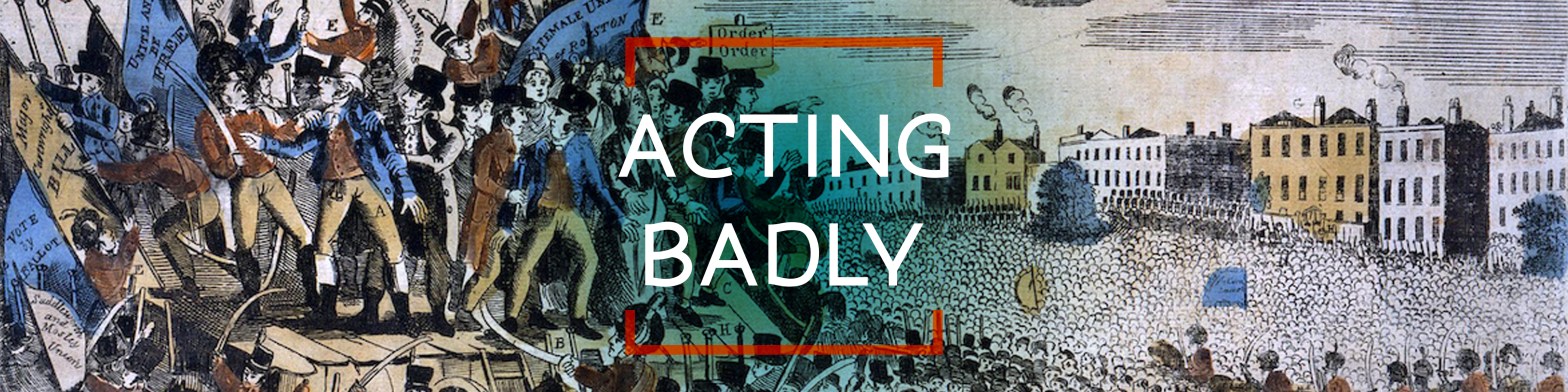
It’s August in Manchester, one of the most pleasant times of year in that part of England. It seems, in many ways, like a normal day, but the town is about to become the site of what will go down in history as a massacre.
On this day, like others, the center of the city buzzes with life. Carriages, horses, and pedestrians all bustle on about their business. But there’s a bit more excitement than usual, because on this August day in 1819, 60,000 people have gathered in St. Peter’s fields. And their presence has the city’s government on edge.
All was not well in Britain. Recent laws had made a hard life even harder for the lower classes and many decided they had had enough. Protests were springing up all over the country, proclaiming adamantly that parliamentary reform was needed. This particular protest in Manchester was only one of many, but its size was concerning. Still, the crowd seemed to behave themselves with propriety as they gathered in the space that had been prepared for the purpose. Colorful banners with slogans like “Reform”, “Universal Suffrage”, and “Equal Representation” rippled in the breeze around a cart that was going to serve as the platform. The gathered thousands buzzed with anticipation as they waited for the arrival of the keynote speaker – Henry Hunt.
The 45-year-old Hunt was a reformer and a popular orator, especially known for his calls for universal suffrage. Calling for the government to allow everyone to vote was ambitious in a nation where fewer than 2% of the population could cast a ballot. But Hunt’s charisma was equal to such demands.
A colleague described him as “gentlemanly in his manner and attire, six feet and better in height, and extremely well formed.” He said that at times, when Hunt spoke, “His voice was bellowing; his face swollen and flushed; his gripped hand beat as if it were to pulverise; and his whole manner gave token of a painful energy.” A deeply passionate speaker like Hunt was just the thing to energize a massive crowd.
As the thousands converged on the agreed-upon site, the town’s officials started to panic. The crowd was far larger than they had anticipated and they didn’t know what to do. The group of protestors was the size of an army and, though they were unarmed, the situation still seemed incredibly volatile. The magistrates knew that the mood in the now peaceful protest might suddenly turn sour. They were not about to let that happen. So they pulled out their secret weapon: The Riot Act.
More than a hundred years earlier, when George of Hanover had been crowned King of England, a bunch of people had been very unhappy about it. There had been riots all over the country and the government decided they needed to do something about it, so in 1715, they passed the Riot Act.
The Riot Act stipulated that if a group of twelve or more people were gathered “unlawfully and riotously”, they could be approached by a public official who would read the following:

“Our sovereign Lord the King chargeth and commandeth all persons, being assembled, immediately to disperse themselves, and peaceably to depart to their habitations, or to their lawful business, upon the pains contained in the act made in the first year of King George, for preventing tumults and riotous assemblies.
God save the King.”
The idea was that the gathered assembly would politely listen to the proclamation, then politely disperse. Thus, the crisis would be averted, and order and parliamentary control would prevail. But it didn’t work.
On that day in 1819, when one of Manchester’s officials read the Riot Act, chances are that few or none of the 60,000 protestors even heard him. And even if they did… who is going to take that seriously? It’s like politely asking a dog to stop barking at you.
When they realized that reading the Riot Act didn’t work, the magistrates of Manchester called out the cavalry. Henry Hunt stepped to the makeshift stage, whisked off his hat, and began to address the crowd. Then, from the outskirts of the crowd came the sound of hoofbeats and rattling swords. The yeomanry of Manchester, basically the city’s mounted militia, approached the gathering. Then the over-enthusiastic men rode into the crowd, swords drawn.
An awful, one-sided struggled ensued and before the riders withdrew, somewhere between 10 and 20 protestors lay dead and hundreds more were injured, including women and children. Ten of the protest’s organizers were arrested, including Henry Hunt, who was charged with “unlawful and seditious assembling for the purpose of exciting discontent” and sentenced to 2 1/2 years in jail. The attackers were cleared of any wrongdoing.
Before the meeting, Hunt had warned those planning to come that, “Our Enemies will seek every opportunity by the means of their sanguinary agents to excite a Riot, that they may have a pretence for Spilling our Blood… Our opponents have not attempted to show that our reasoning is fallacious, or that our conclusions are incorrect, by any other argument but the threat of Violence, and to put us down by the force of the Sword, Bayonet, and the Cannon.” His warnings proved all too true.
When faced with disagreement, the city of Manchester really messed up. A mass of people had something to say, and the city’s officials, instead of listening, simply wanted them to go away. They wanted them silenced. Their attempt to tell the crowd of protestors to be quiet and disperse wasn’t very effective, even though it was punctuated with “God Save the King”. So they resorted to violence. 1819 Manchester handled disagreement very poorly, but do we do any better?
Proverbs 18:13 warns, “He that answereth a matter before he heareth it, it is folly and shame unto him.”
Sometimes, when we come across someone we disagree with, we get scared. We are uncomfortable with disparate opinions, so our knee-jerk reaction is to try to shut them up. Many of us respond to disagreement with our fists up, then if we can’t score the knock-out blow, we run away with our fingers in our ears, lest we begin to hear their side of the argument. Perhaps we would do better to put our fists down and open our ears.
James wrote in his epistle, “Let every man be swift to hear, slow to speak, slow to wrath.” (James 1:19)
James was probably talking mainly about being ready to hear from God, but more broadly, if we claim to follow God, we ought to be good listeners. If we are slow to speak, we tend to be more thoughtful when we open our mouths. There is more likelihood that our words will be measured and mature. And if we wait a bit before we speak, we may just find that what we planned to say is, simply, unnecessary.
We could all be better listeners. Many of us, when we’re engaged in conversation, aren’t really listening. We’re just waiting for an opportunity to talk. We have little interest in understanding what someone else has to say. We mostly just care about making our own opinion heard. As followers of a God who is always so ready to listen to His children, we ought to be exemplary listeners.
Maybe that person who disagrees with you has a message you need to hear. Even if they are wrong, very few people are ready to listen to truth and reason until they feel like they have been heard. Don’t be afraid of people who disagree with you and don’t follow your gut instinct of spewing an angry rebuttal every time you hear something you don’t like. Be ready to listen.
If you listen closely enough, you might learn something. You might be wrong sometimes, too. The crowd of protestors might be inconvenient, but maybe Henry Hunt’s eye-popping fist-pumping speech has a nugget of truth you need to hear. We all need a little help with our understanding from time to time. Don’t be like the magistrates of Manchester. Give the crowd your ear before you put them to the sword.
Don’t send in the cavalry until they’ve had their say and, for goodness sake, don’t read them the Riot Act.
History of the Riot Act: https://www.atlasobscura.com/articles/read-the-riot-act-meaning
Eyewitness account of the incident in Manchester: http://www.peterloomassacre.org/eyewitness.html
More about Henry Hunt: https://spartacus-educational.com/PRhunt.htm
Hunt’s letter to the protestors in Manchester: https://historyofinformation.com/image.php?id=8626
 Exempla