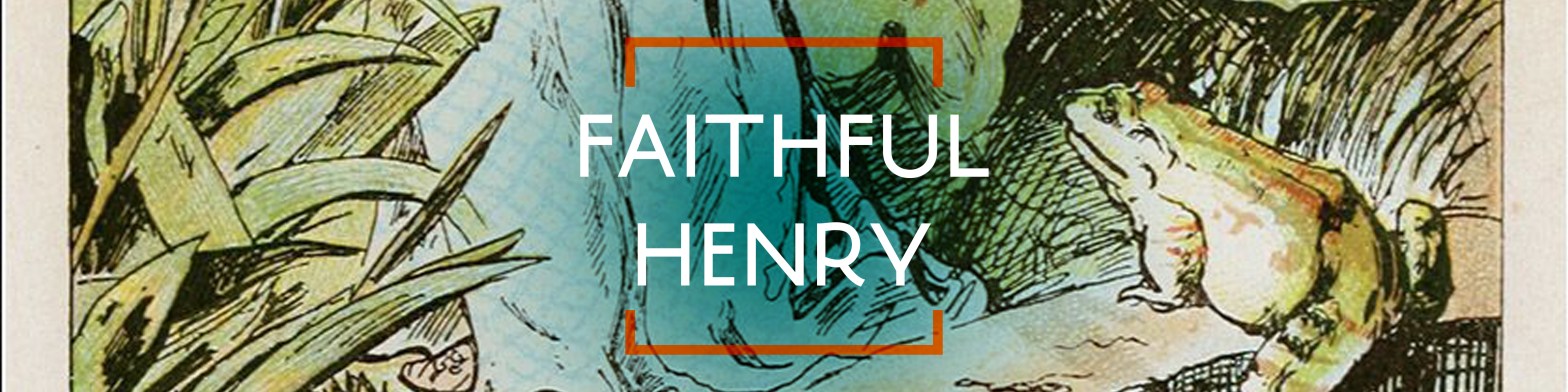
This tale, like many of its kind, begins with a princess.
“One fine evening, a young princess put on her bonnet and clogs and went out to take a walk by herself in a wood. And when she came to a cool spring of water that rose in the midst of it, she sat herself down to rest a while. Now, she had a golden ball in her hand which was her favorite play thing and she was always tossing it up into the air and catching it again as it fell. After a time, she threw it up so high that she missed catching it as it fell and the ball bounded away, rolled along upon the ground, till at last it fell down into the spring.”
Ah yes, dropping the golden ball in the spring… classic mistake. This story may be familiar to you – it is the classic fairy tale of the Frog Prince by Jacob and Wilhelm Grimm. And you might be thinking, “Fairy tales, really?” But hear me out.
You likely know the popular modern version of this story. The princess drops her precious golden ball down into the spring. A frog pops out and agrees to fetch it for her if she will take him home and make him her constant companion. Now the princess finds this to be a foolish proposition, but she thinks she can easily get her ball back without holding up her side of the deal. The frog fetches the ball. The princess snatches it and runs back home, but the frog is obnoxiously insistent. He shows up at the palace, knocks on the door, and demands she honor her promise. His persistence is rewarded. The princess gives in, takes the frog to dinner, she kisses him, he turns into a prince, they get married and live happily ever after.
But, that’s not quite how the original story goes. In the first version of the story, there is no kiss. In fact, the princess gets so fed up at the frog that she flings him at the wall and that’s when he turns into a prince.
There is also another portion of the original story that is unfamiliar to most of us. See, the day after the frog’s baffling metamorphasis back into a prince, a magnificent carriage pulls up, “with eight beautiful horses, decked with plumes of feathers and a golden harness”.
This gilded carriage is from the prince’s kingdom. At the back of the coach rides one of the prince’s servants. It is a young man named Henry, who is overjoyed to see his master not only restored to human form but about to marry a beautiful princess. Henry helps them into the carriage and takes his place at the back.
As they drive off into the sunset, the prince and princess are suddenly jolted by a loud cracking sound behind them. The prince calls out to Henry in alarm, convinced that the carriage is breaking apart underneath them.
But Henry replies, “No, no, my lord, it’s just my heart. When you were living in the well, when you were a frog, I suffered such great pain that I bound my heart with iron bands to stop it from breaking, for iron is stronger than grief. But love is stronger than iron, and now you’re human again the iron bands are falling off.”
Wow, a little dramatic, don’t you think, Henry?
“Hey!”
As odd as this part of the story may sound, I think Henry has a lesson to teach us.
In John chapter 3, the followers of the John the Baptist comes to him distraught. The crowds following John seemed to be thinning and they have discovered that the primary reasons seems to be that people are flocking to Jesus. It feels unfair. After all, John helped introduce Jesus. It was he who cried, “…Behold the Lamb of God, which taketh away the sin of the world.” (John 1:29) It was John who baptized Jesus. And now, John’s popularity seems to be fading as Jesus takes the spotlight.
But in the face of these concerns, John responds to his followers, “A man can receive nothing, except it be given him from heaven. Ye yourselves bear me witness, that I said, I am not the Christ, but that I am sent before him.” (John 3:27-28)
Then, John uses an insightful illustration. He says,
“He that hath the bride is the bridegroom: but the friend of the bridegroom, which standeth and heareth him, rejoiceth greatly because of the bridegroom’s voice: this my joy therefore is fulfilled.” (John 3:29)
I have been part of the wedding party in five or six weddings, but I’ve only been the groom once. All the other times, I was a groomsman. And in each of those weddings, there were things I liked and things I didn’t like, like the time I had to wear a bright pink tie. Oh, and bright pink socks. If it had been up to me, there are probably things I would have changed about every one of those weddings. But it would have been the height of foolish selfishness for me to demand that things go my way. In fact, it would have been inappropriate for me to demand that any of the attention go to me. A groomsman might think the decorations are dumb, or the reception stinks, or his shoes are uncomfortable, or a song is annoying, but that doesn’t matter because it’s not about him. The day is all about the bride and groom and a good groomsman finds his joy in seeing their joy.
Why did Henry consider it necessary to put iron bands across his heart? Whose sorrow was it that caused Henry so much grief? It was not personal sorrow brought on by any hardship of his own. It was the prince’s sorrow that grieved Henry’s heart. The joy he experienced at the close of the story was not because of his circumstances. He was sharing in the joy of his master. Henry cared deeply for the prince. When the prince wept, Henry wept. And when the prince rejoiced, Henry rejoiced.
In John 3, John was happy about Jesus’ success, even though it drew attention away from him. He was not jealous or angry. His heart is most aptly expressed in his own words:
John 3:30 “He must increase, but I must decrease.”
That certainly ought to be our attitude about Christ. It’s not about us, it’s about Him! But that attitude also ought to mark our relationship with others.
Romans 12:15 exhorts us to “Rejoice with them that do rejoice, and weep with them that weep.” It’s a familiar concept to many of us, but really hard to practice sometimes. Have you ever been there, showing up in just the wrong mood for what you’re about to be a part of?
Maybe you were having a rotten day, feeling down about events in your life, maybe plagued with anxiety because of challenges you were facing, and there you are for a wedding. And all you want to do is cry, but you have to try to put on a smile on your face and laugh and rejoice with the couple as they celebrate their special day.
Maybe you’ve had just the opposite experience. You were having a great day. Life was good, it seemed like you had lots to look forward to. You felt like joking and laughing and… you were there for a funeral. You had to try to wipe the grin off your face and join in the solemn sorrow of a family grieving their loss.
Why is it so hard? It’s because we are so selfish. Because we don’t like setting aside our own feelings to share in the feelings of others. We want others to join in our joys and our sorrows, but we have a hard time joining in the joys and sorrows of others.
We like to be the groom, not the groomsman. We like to be the star player. We don’t like to be the water boy.
Do we truly rejoice in the joys of others? When evil befalls our spiritual siblings, do our hearts break with them, even if their sorrow does not touch us personally? When good comes to them, do our hearts rejoice, even if their advantage means our disadvantage?
We have no need to imprison our hearts with iron bands, but let us ask God to help us abandon selfishness and truly enter into the joys and sorrows of others. Let us be like faithful Henry. Or better yet, like faithful John – content to be the bridegroom’s friend.
You can read the full story of the Frog Prince here: https://www.shelf-awareness.com/max-issue.html?issue=29#m58
 Exempla